The machines behind AI,
demystified.
A free, neutral map of how AI hardware is produced: every layer, who dominates, and where it bottlenecks.A free, neutral map of how AI hardware is produced: every major layer from chips to data centers, who dominates each, and where the bottlenecks are.
The stack, layer by layer
From sand to a trained model
AI hardware is a chain of dependent steps, and the slowest link sets the pace. Expand any layer to see what it does, who dominates it, and where it bottlenecks.
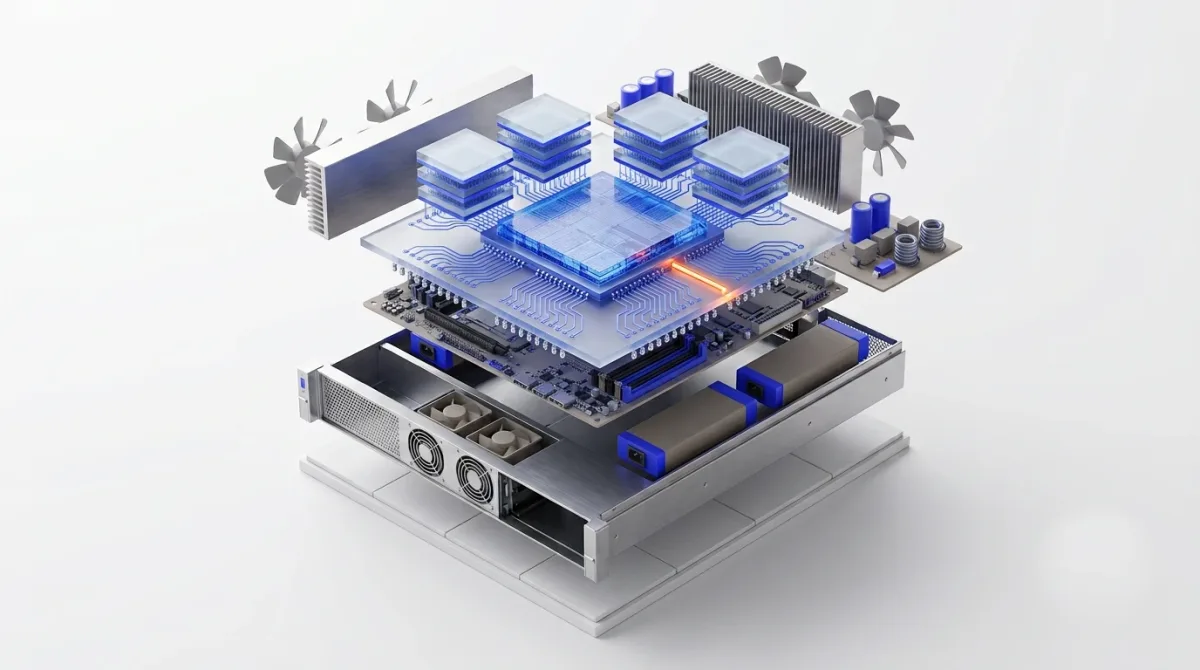
The compute engines that run AI training and inference. GPUs (graphics processing units) dominate because their massively parallel design maps well onto the matrix math behind neural networks; dedicated accelerators (TPUs, custom ASICs) chase the same workloads with more specialized silicon.
- NVIDIA holds the large majority of the AI training market, helped as much by its CUDA software ecosystem as by the chips themselves.
- Alternatives exist: AMD's Instinct GPUs, Google's TPUs, Amazon Trainium/Inferentia, Microsoft Maia, and startups like Cerebras and Groq.
- A modern AI accelerator is defined less by raw FLOPS than by memory bandwidth, interconnect, and how many can be linked into one coherent system.
- Each generation packs more transistors, faster memory, and tighter chip-to-chip links, which is why frontier training keeps scaling.
Where it bottlenecks
Demand far outstrips supply for the newest accelerators; allocation is gated by advanced packaging and memory rather than raw wafer output.
A neutral, factual overview compiled for general understanding, not investment or procurement advice. The industry moves quickly: verify specifics against primary sources before acting.
The slowest link sets the pace.
AI compute is scarce even when one input is plentiful, because every accelerator depends on a chain of steps: a fabricated die, stacked HBM memory, advanced packaging to join them, then networking, servers, power, and cooling to put them to work.
The binding constraint rotates. For long stretches it has been high-bandwidth memory and CoWoS-class packaging; increasingly it is grid power for the data centers themselves. Relieving one chokepoint often just exposes the next.
Concentration compounds scarcity: leading-edge fabrication, EUV lithography, and HBM each rest on a very small number of suppliers, mostly in a few countries. That is the structural reason hardware shapes the pace of AI.
Keep exploring
Related AI tools
Enjoyed this? Get the weekly AI recap.
One free email a week: what moved in AI and why it matters, in plain language. No spam, unsubscribe anytime.
Free downloads
delivered by email.
Pick a document and we email you the PDF.